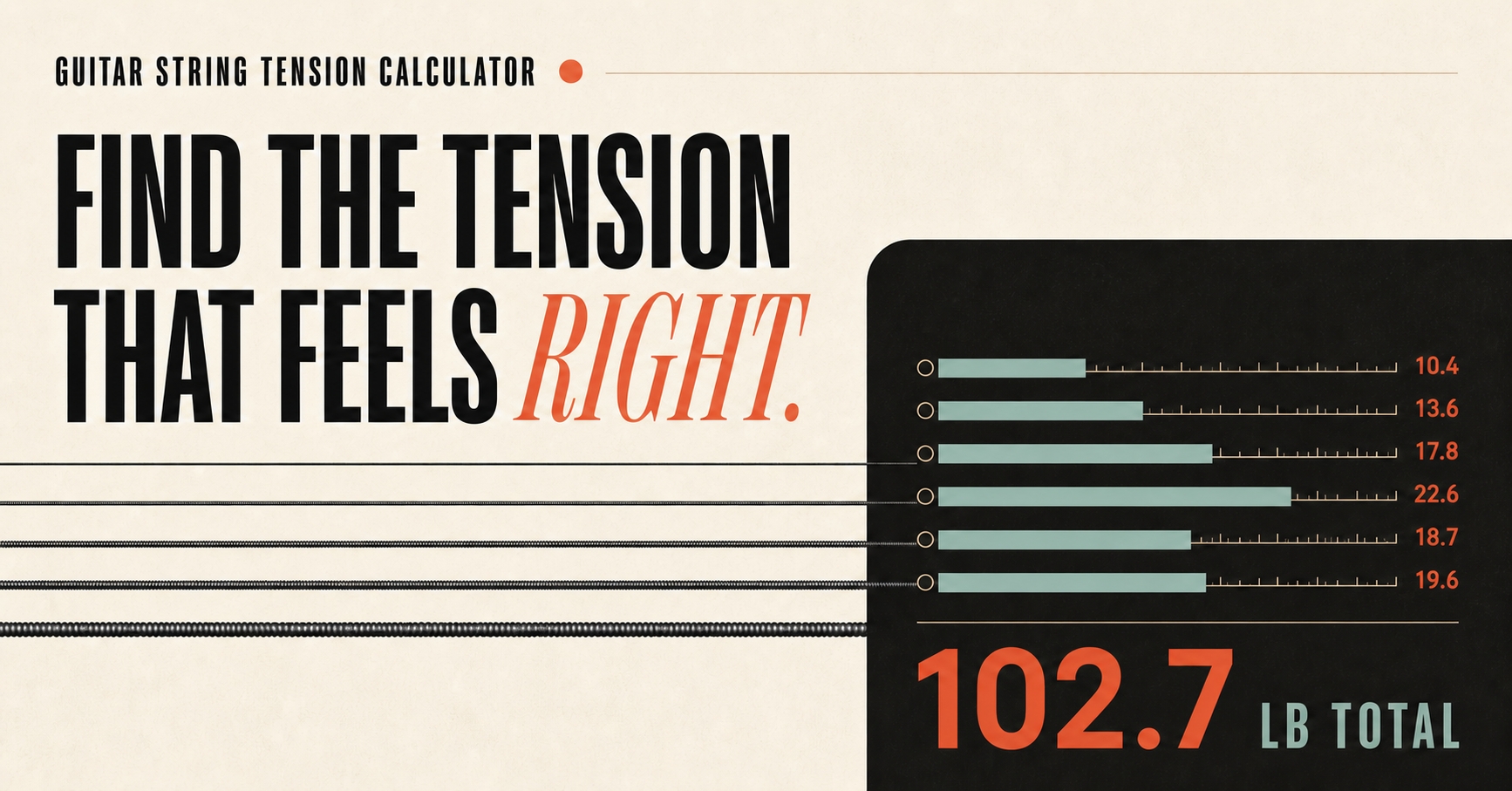
Why String Tension Is a Profile, Not Just a Total
A 100-pound guitar set can feel balanced or awkward depending on how that pull is distributed across individual strings.
Read article →Journal / practical setup guides
Find focused explanations, practical comparisons, and setup ideas you can test on your instrument.
By Guitar String Tension CalculatorReviewed 2026-08-09
Journal guide
A 100-pound guitar set can feel balanced or awkward depending on how that pull is distributed across individual strings.
Read article →Outside gauge labels do not reveal wound-string core size, wrap geometry, material, or bending stiffness.
Read article →Lowering E2 to D2 cuts tension by roughly 21 percent with the same string, so the sixth string often needs separate attention.
Read article →The choice affects bending stiffness, intonation behaviour, tone, and unit weight—not only the printed gauge.
Read article →A fanned-fret instrument gives each string a different speaking length, so one average scale cannot describe the setup.
Read article →Mark every fret from the nut instead of adding rounded consecutive gaps, and verify the printed scale before cutting.
Read article →The reference sets the frequency of every equal-tempered note, while the guitar’s interval pattern determines each open string.
Read article →Measure nut to 12th fret and double it; saddle compensation makes direct nut-to-saddle measurements misleading.
Read article →Treat the seventh string as part of a tension profile instead of adding the largest gauge that fits the hardware.
Read article →Higher tension can reduce fretting deflection, but action, stiffness, relief, saddle position, and playing pressure still determine intonation.
Read article →Acoustic sets use dense wrap materials and higher common gauges, so large changes deserve attention to the instrument’s condition and design.
Read article →Scale, tuning, gauges, and per-string tension make a setup reproducible in a way that pack names alone cannot.
Read article →