Start here
Key takeaways
- Open-string tension affects fretting response but does not determine intonation by itself.
- Action, relief, construction, fret height, saddle position, and finger pressure also affect fretted pitch.
- Set intonation only after the final strings, tuning, relief, and action are stable.
- Use tension to identify outliers, then verify the instrument mechanically.
How to use this: Use the examples to compare options, then confirm product-specific details with the linked manufacturer references and your own instrument.
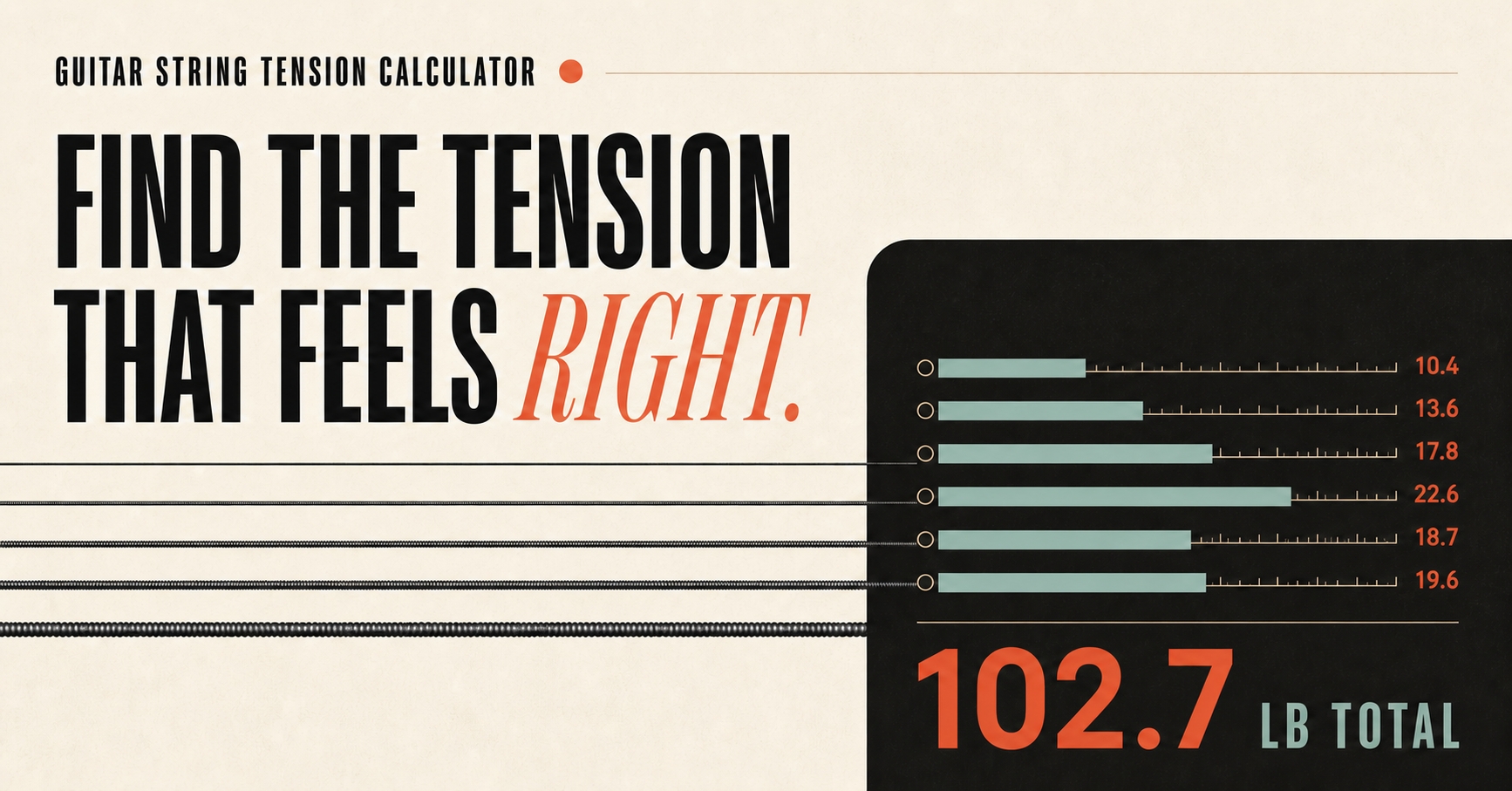
String tension influences how much a fretted note rises when the player pushes the string toward the fretboard. It is therefore related to intonation, but the open-string tension number cannot predict the complete result.
Fretting stretches the string
A string must travel downward to meet a fret. That path increases its length and tension, raising pitch. Higher action, tall frets, and strong finger pressure increase the effect.
A firmer string usually deflects less under the same force, but stiffness and construction also matter. A wound string with a large core may need different compensation from another string with similar open tension.
Saddle compensation corrects the system
The saddle is moved away from the nut so fretted notes align more closely with equal temperament. The correct position depends on gauge, construction, action, relief, and the player’s attack.
That is why intonation should be set after the final strings, tuning, relief, and action are stable.
Use tension as one diagnostic
If one string is much softer than its neighbours, fretting pressure may push it sharper more easily. Balancing the profile can make playing response more predictable, but it does not eliminate the need to adjust the saddle.
Use the tension calculator to identify large outliers. Then check the setup mechanically rather than assuming a number alone will fix intonation.
Set intonation after the variables that move it
Install the final strings and tune them to the final pitch before adjusting saddles. Set neck relief and action next because fretting distance changes how far the string must be displaced. Check nut behavior and tuning stability, then compare the open note with the 12th-fret fretted note.
Retune after every saddle movement. Moving the saddle changes speaking length and therefore the open pitch. Use normal playing pressure and hold the guitar in playing position so the test represents how the instrument is actually used.
- Fit and stabilize the final gauge and construction.
- Set relief, bridge position, and action.
- Tune the open string precisely with a suitable tuner.
- Compare the 12th-fret fretted note, not only the harmonic.
- Move the saddle, retune the open string, and repeat.
- Check additional frets used in your playing and choose the best practical compromise.
Diagnose the pitch pattern before moving the saddle
A sharp 12th-fret note usually calls for a longer effective string, while a flat note calls for a shorter one. That rule assumes the open string is correct and the setup is otherwise healthy. First-position sharpness can point to a high nut slot or excessive pressure rather than the 12th-fret saddle adjustment.
If one note behaves strangely while nearby frets do not, inspect fret condition. If the pitch wavers, check old strings, pickup magnetic pull, and unstable hardware. Intonation adjustment cannot repair every cause of an inaccurate tuner reading.
| Observed pattern | Likely area to inspect | Why |
|---|---|---|
| 12th-fret fretted note sharp | Move saddle back after checks | Longer speaking length flattens the fretted note |
| 12th-fret fretted note flat | Move saddle forward after checks | Shorter speaking length sharpens the fretted note |
| First few frets sharp, octave acceptable | Nut slot and finger pressure | Excess displacement is greatest near the nut |
| Warbling upper notes | Pickup height or string condition | Magnetic pull or a damaged string can disturb pitch |
Use tension to explain sensitivity, not to replace setup work
A softer string can be pushed farther by the same hand, so player pressure may sharpen it more easily. A stiffer string may require different compensation even at similar open tension. This is why unit weight, open pull, and bending stiffness should not be treated as interchangeable numbers.
Use the tension profile to identify a possible outlier, then verify pitch on the instrument. If a gauge change improves attack but the saddle reaches its travel limit, the bridge geometry still sets the boundary. The final test is a stable note across the parts of the neck you play.
Include the player in the intonation test
A technician can set a precise octave with a light touch, yet the guitar may play sharp when the owner grips tall frets firmly. Compare tuner readings with a deliberately light, normal, and heavy fretting pressure. The spread shows whether technique and setup sensitivity are part of the complaint.
Capos add another pressure source. Place the capo immediately behind the fret and use only enough force for clean notes. If chords become sharp after the capo is fitted, compare its tension and placement before changing saddle compensation that already works without it.
Check the musical register that matters. A player who works above the 12th fret may choose a slightly different practical compromise from a rhythm player who lives in first position. Equal temperament and physical strings cannot make every interval beat-free, so judge stable pitch patterns rather than chasing a motionless display everywhere.
Save the final tuner reference, string age, and saddle positions. Those details make a later change in pitch behavior easier to distinguish from a forgotten calibration or worn set.
- Use the final pick attack and fretting pressure during the test.
- Check open, 12th-fret, and two musically important fret positions.
- Test capo use separately from the open-neck setup.
- If pressure changes pitch dramatically, inspect action, nut height, and fret height.
Reference material
Technical references
Use these references when you need the source equation, product-specific information, or a second explanation of the setup method.
- Intonation After String ChangesFender
- String Tension Specifications and FormulaD'Addario
- Complete Guide to Guitar IntonationMusicNomad
- How Strings, Tension, Tuning, and Intonation Affect ToneGuitar.com
- The Physics of Guitar String CompensationLoyola Marymount University