Start here
Key takeaways
- Drop D changes only the sixth string from E2 to D2.
- The unchanged string retains about 79.4% of its E2 tension after the two-semitone drop.
- Solve from a known target tension instead of assuming one low-string gauge suits every scale.
- Check nut movement and intonation after choosing the final low string.
How to use this: Use the examples to compare options, then confirm product-specific details with the linked manufacturer references and your own instrument.
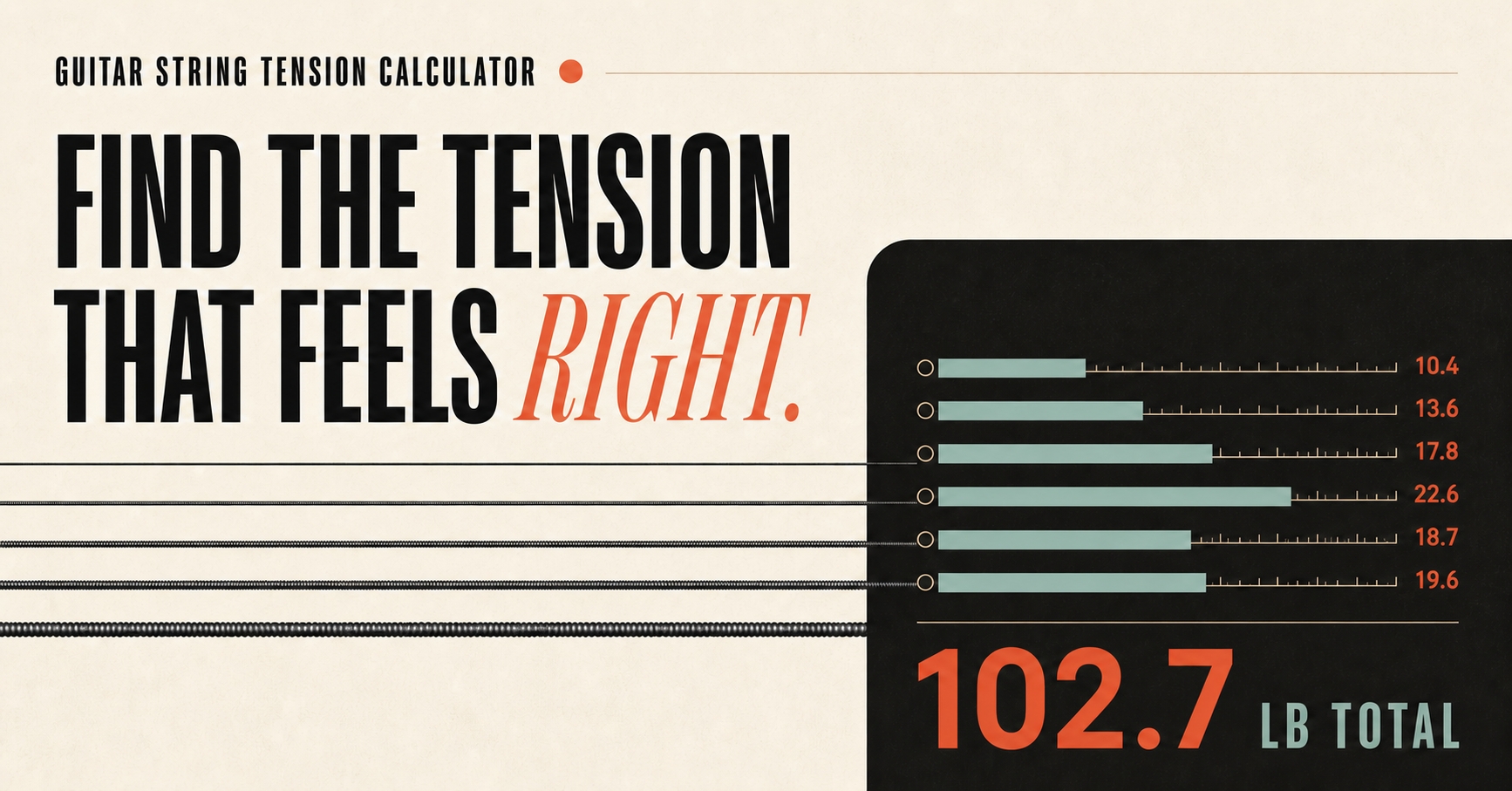
Drop D keeps the upper five strings in standard tuning and lowers only the sixth string from E2 to D2. That one whole-step change reduces theoretical tension to about 79.4% of its original value when gauge and scale remain unchanged.
Why the sixth string becomes the outlier
On a regular 10–46 set, the upper five strings keep their familiar response while the .046 low string becomes noticeably softer. Some players enjoy that contrast for easy bends and aggressive vibrato. Others hear a less focused attack or push the note sharp when fretting hard.
Recreate the previous tension
The cleanest method is to calculate the original E2 tension, change the note to D2, and use reverse gauge mode to solve for the gauge that restores the target. Because wound-string construction varies, the calculated gauge is a starting point rather than a product guarantee.
At 25.5 inches, many players move from .046 to something around .048 or .050. A shorter scale may need more gauge; a longer scale may need less.
Check the setup after the change
A two- or four-thousandth increase is often modest, but the string can still sit differently in the nut slot and require a new saddle position. Tune to pitch, check for binding, play notes near the first few frets, and then verify intonation at the 12th fret.
Load the Drop D preset in the main calculator to compare the low string against the rest of the set. For lower tunings, the Drop C gauge guide shows how the same reasoning scales up.
Choose the low D by target response, not genre label
Drop D lowers only the sixth string, so the useful question is how that D2 should respond beside the unchanged A2 string. Some players want the same numerical tension the low string had at E2; others intentionally keep it softer for vibrato and a looser attack. Both choices are valid when they are deliberate.
A simple plain-string ratio suggests multiplying gauge by about 1.122 to restore tension after a two-semitone drop. That would move .046 toward .052. Real wound strings do not scale perfectly by outside diameter, so .048, .050, and .052 are sensible nearby tests rather than universal answers.
| Starting low E | Nearby Drop D tests | Likely use |
|---|---|---|
| .042 | .044–.048 | Light touch or longer scale |
| .046 | .048–.052 | General-purpose comparison range |
| .049 | .052–.056 | Firm attack or shorter scale |
These are test ranges. Construction, scale, and preferred response can move the final choice.
Listen for the problem before adding gauge
Play open D, a fretted power chord near the second fret, and the same rhythm near the 12th fret. If the open note is controlled but fretted notes go sharp, finger pressure, nut height, action, or intonation may be more important than additional tension. If the note wavers under the pick, compare a slightly heavier low string.
Test through the amp sound you actually use. Distortion and compression can make pitch instability more obvious, while aggressive picking can sharpen the initial attack. Record the same riff so volume differences do not decide the result by themselves.
- Soft attack but good intonation: compare one heavier low string.
- Sharp first-position notes: inspect nut height and fretting pressure.
- Sharp 12th-fret note: set intonation after the final gauge is installed.
- Tuning catches or jumps: check nut-slot width and lubrication before blaming gauge.
Install and set up the final low string in the right order
Confirm that the string passes through the tuner, nut, bridge, and any locking hardware without forced modification. Install it, stretch gently, and stabilize tuning. On a floating tremolo, changing one string can still alter bridge balance, so return the bridge to its intended position before measuring action.
Check relief and action, then set intonation last. Revisit the setup after a full playing session because a new string can settle at the tuner and bridge. Save the exact product and gauge once the low D behaves the way you want.
Plan for guitars that switch between standard and Drop D
A dedicated Drop D guitar can optimize the sixth string for D2. A guitar that returns to E2 during the same set needs a compromise because the heavier string gains roughly 26% tension when raised from D to E. A low string chosen to feel firm at D may feel much firmer than the rest at E.
Calculate both tunings before buying singles and compare the sixth string with the fifth in each state. Choose the smallest gauge that controls Drop D without making E standard uncomfortable. The result may be softer than a dedicated Drop D setup, but it avoids two opposite outliers.
A drop-tuning device changes pitch quickly but does not remove the underlying tension change. Check that the device returns accurately, the string does not bind at the nut, and intonation remains acceptable in the parts of the neck used for both tunings. Save two test riffs so the compromise is judged in context.
If neither tuning feels acceptable with one string, the clean answer may be a dedicated instrument or a setup change rather than a more extreme gauge. That keeps each guitar inside a narrower, more predictable range.
- Dedicated Drop D: prioritize D2 attack and intonation.
- Frequent D/E switching: compare both profiles before selecting gauge.
- Floating tremolo: expect tuning interactions unless the bridge is stabilized.
- Drop device: verify repeatable return to pitch after several cycles.
Reference material
Technical references
Use these references when you need the source equation, product-specific information, or a second explanation of the setup method.
- String Tension Specifications and FormulaD'Addario
- Intonation After String ChangesFender
- Best Strings for Drop D TuningS.I.T. Strings
- Best Strings for Alternate Guitar TuningsD'Addario
- String Gauges for Standard and Drop TuningsErnie Ball