Start here
Key takeaways
- The 10–46 label does not identify every intermediate gauge or the construction of the wound strings.
- Core diameter, wrap geometry, alloy, and winding style affect unit weight and stiffness.
- Two strings can share an outside diameter while feeling and calculating differently.
- Use manufacturer unit weight when matching a named product precisely.
How to use this: Use the examples to compare options, then confirm product-specific details with the linked manufacturer references and your own instrument.
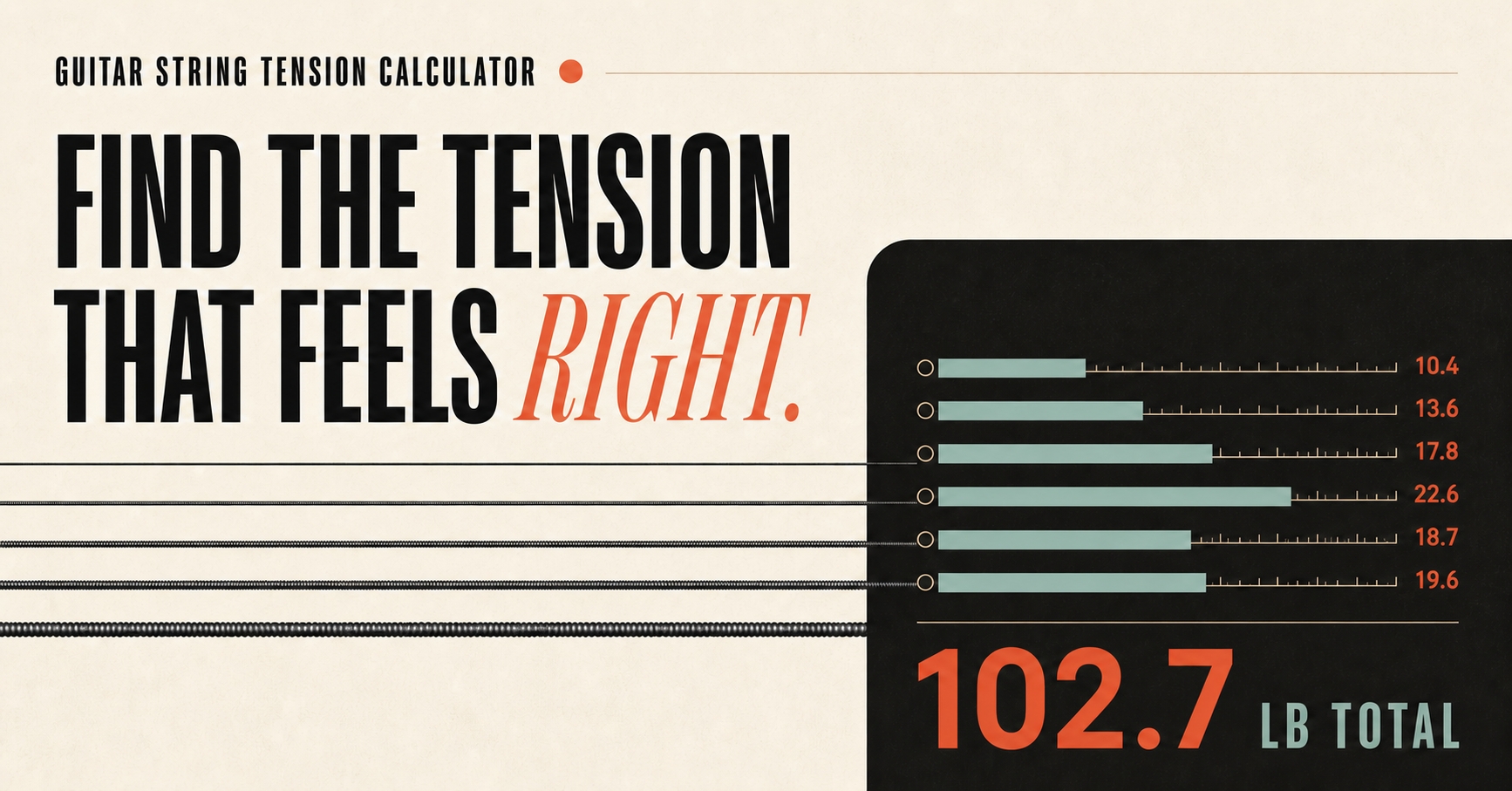
The label 10–46 tells you the outside diameter of the thinnest and thickest strings. It does not define every intermediate gauge, and it does not reveal how the wound strings are built.
Plain strings are comparatively simple
A plain .010 string is usually a single steel wire. If material and diameter are known, its mass per unit length can be estimated from density and cross-sectional area. That makes tension comparisons between plain strings relatively direct.
Wound strings hide important dimensions
A .046 wound string contains a core and one or more wraps. The outside diameter may match another .046 string while the core diameter, wrap diameter, packing, and material differ. Those changes affect unit weight and bending stiffness.
A larger core can feel firmer during fretting even when open-string tension is similar. A different wrap material can change mass without changing the label printed on the package. Round-core and hex-core construction can also respond differently under the fingers.
What a calculator can estimate
When exact manufacturer unit-weight data is unavailable, a general calculator must use a construction model. Guitar String Tension Calculator estimates a core ratio and packed wrap region. Use the result to compare tunings and scales, then check a specific product against its manufacturer’s data.
If precise product matching matters, use manufacturer unit weights where available. Entering those values would be more reliable than inferring them from outside gauge alone.
If a set label has you second-guessing what’s actually in the package, the guitar string gauge chart breaks down what common labels really mean, and the tension methodology documents the construction model behind every estimate on this site.
Run a fair comparison between two sets
Set up the guitar for one product and record relief, action, bridge angle, pickup height, and intonation. Record a short passage with clean and driven sounds. Install the second set, stabilize it, restore any setup values that moved, and repeat with the same pick and input level.
Compare immediately and again after similar playing time. A new set often sounds brighter than the worn set it replaces, which can be mistaken for a permanent construction difference. Blind the recordings or match their loudness if possible so the louder take does not automatically seem better.
- Use equal playing time or compare two fresh sets.
- Keep tuning, scale, action, and pickup height constant.
- Score bends, fretting pressure, attack, string noise, and tuning separately.
- Save the exact package code, not only the 10–46 label.
Know what the tension comparison can and cannot settle
Published unit weight can explain a difference in open-string tension. It cannot fully predict bending stiffness, friction at contact points, coating texture, or the amount of string beyond the nut and bridge. A model based only on outside diameter must make even more assumptions for wound strings.
Use the calculator to identify likely tension differences and preserve a useful profile across tunings. Use the guitar to decide feel, tone, fit, and intonation. When the two sources of evidence disagree, record the product and playing observation instead of forcing the model to explain a variable it does not contain.
Diagnose a feel difference before changing the setup
Begin with the location of the difference. If bends changed only on plain strings, verify their intermediate gauges and the tremolo response.
If fretting changed mostly on wound strings, construction and core ratio become stronger suspects. If every string changed, relief, bridge angle, or scale perception may have moved during installation.
Tune both sets to the same reference and measure action before comparing. A floating bridge can tilt when total pull changes, raising or lowering every string. Pickup distance can also change output and magnetic pull when action moves, creating an audible difference that is not solely in the string design.
Use a fresh reference set if the result matters. Old strings accumulate wear, contamination, flat spots, and intonation error, so a new product will usually feel and sound different even if construction is similar. Equalize age and setup before attributing the result to round core, hex core, alloy, or coating.
When one product wins, write down the reason in observable terms. “Cleaner low-string attack with the same action” is more reusable than “feels better,” and it tells you which property to protect when another gauge or tuning is needed.
- Plain strings only: verify complete gauge list and tremolo movement.
- Wound strings only: compare exact construction and unit weight.
- All strings: measure relief, action, bridge angle, and pickup height.
- Tone only: match string age, recording level, and playing position.
Reference material
Technical references
Use these references when you need the source equation, product-specific information, or a second explanation of the setup method.
- Electric String Materials and ConstructionD'Addario
- String Tension Specifications and FormulaD'Addario
- Guitar String Construction ExplainedS.I.T. Strings
- Same Guitar, New Sounds: A Guide to StringsAcoustic Guitar