Start here
Key takeaways
- Every string on a multiscale guitar has its own speaking length.
- A single average scale hides the bass-side tension increase the design is intended to provide.
- Tension changes with scale length squared when pitch and string construction remain fixed.
- The neutral fret affects ergonomics and fan geometry, not the entered endpoint scale lengths.
How to use this: Use the examples to compare options, then confirm product-specific details with the linked manufacturer references and your own instrument.
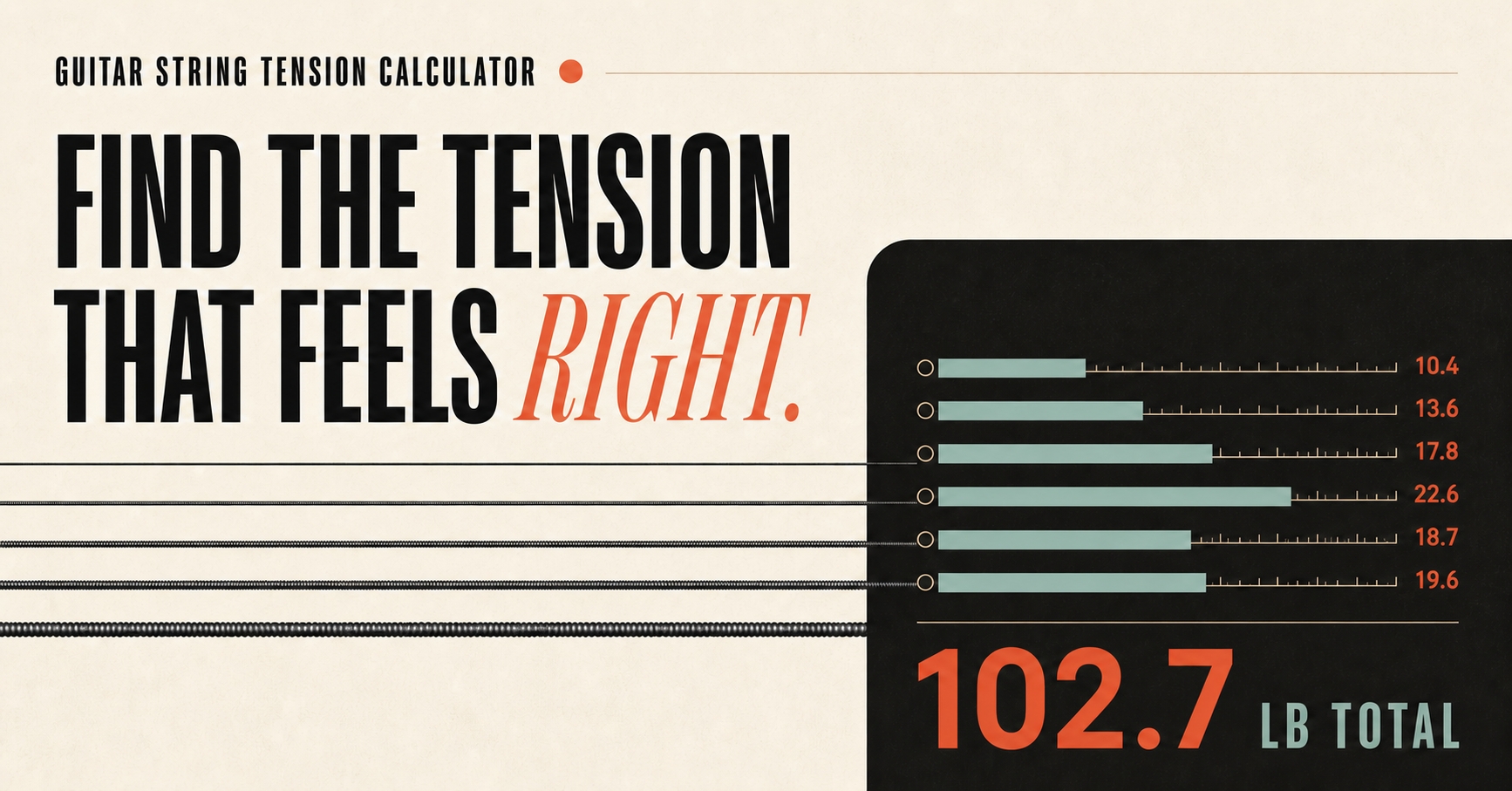
A multiscale guitar uses a shorter scale on the treble side and a longer scale on the bass side. The frets fan between those endpoints, with one neutral fret crossing the centreline at a right angle.
Every string has its own scale
On a 25.5–27.5 inch eight-string, the first string may speak at 25.5 inches while the eighth speaks at 27.5. The six strings between them occupy intermediate lengths. Entering 26.5 as one average hides the exact relationship that the design was created to provide.
Guitar String Tension Calculator multiscale mode interpolates between the treble and bass endpoints. That is appropriate for a regular linear fan. Unusual bridge or nut geometry may require measured per-string scales.
Why the bass side benefits
Tension is proportional to scale length squared. A longer low-string scale therefore raises tension without requiring as much outside gauge. It can also reduce the relative stiffness problem that appears when a very thick string is used on a short scale.
The treble strings retain a shorter scale, keeping familiar fret spacing and bend response.
Tension is not the only design variable
Longer speaking length also changes fret spacing and where the bridge must sit. The neutral fret controls wrist geometry and how dramatic the fan feels. Pickup blade or pole-piece coverage, bridge hardware, and intonation range must match the layout.
Once you know both edge scales, the fret calculator will build the treble- and bass-side measurement tables you need to lay out the board, and the seven-string gauge guide or the main calculator’s eight-string mode can take it from there to balance the actual tuning.
Treat a multiscale guitar as several real scale lengths
A 25.5–27-inch label gives the two endpoints, not one average scale. In a regular linear fan, the intermediate string lengths can be interpolated between those endpoints. Each resulting length belongs in its own tension row because scale is squared in the equation.
An average can hide the exact benefit on the lowest string and overstate tension on the highest. Measure the actual nut and bridge geometry when the fan is non-linear, the bridge is unusual, or the manufacturer publishes per-string dimensions.
| Input mistake | What it hides | Better method |
|---|---|---|
| One average scale for all strings | Bass and treble endpoint differences | Use one length per string |
| Only the longest scale | Actual treble response | Enter both endpoints and interpolate |
| Ignoring string count | Spacing of intermediate lengths | Map every string position |
| Using catalog scale after hardware changes | Real witness-point geometry | Measure the instrument |
The neutral fret changes ergonomics, not the tension equation
The neutral fret is where the fretwire sits closest to perpendicular to the neck centerline. Moving it changes how the fan is distributed toward the nut and bridge, which can affect wrist position and the visual angle of chords. It does not change a string’s tension if that string’s speaking length, pitch, and unit weight remain the same.
Try common chord shapes, low-string riffs, and upper-fret leads before judging a fan from its endpoint numbers. A dramatic bridge fan can suit one technique while a dramatic nut fan may feel unfamiliar in first position. Hardware position and pickup coverage also need to match the design.
- Check first-position barre chords for wrist comfort.
- Check bends on the short treble side and hard attack on the long bass side.
- Confirm the bridge has enough intonation travel for every string.
- Confirm pickups sense the outside strings across the full fan.
Balance a multiscale set without erasing its purpose
Start with a familiar straight-scale setup and save its per-string profile. Enter every multiscale length and the intended tuning, then choose nearby real gauges. Do not force identical numbers across all strings; preserve the treble bend response and bass attack you actually want.
After installation, set relief and action before intonation. Assess fretted pitch and attack on each string because very thick low strings can remain stiff even when the calculated open tension looks balanced. Save the endpoint scales, neutral fret, gauges, and product construction with the final setup.
Check the details a two-number scale label cannot show
Two guitars can share 25.5–27-inch endpoints and feel different because string count and neutral-fret position distribute the fan differently. Neck width, bridge spacing, fret count, and the location of the perpendicular fret also affect the angle experienced by the hand. Compare the full geometry rather than shopping by endpoint numbers alone.
Confirm the installed string set and lowest note during a test. A well-chosen gauge can make one model seem more balanced than another even when the scale design is similar. If possible, calculate both factory setups and then imagine the same target profile on each instrument.
Inspect replacement-string length and taper. Extended scales, string-through bodies, reverse headstocks, and long headstock runs can place the wound or tapered portion incorrectly. Manufacturers sometimes offer strings specifically sized for long or multiscale instruments, so outside gauge is not the only fit dimension.
Finally, check access to suitable single strings before committing to an unusual tuning. A multiscale design gives more control over response, but the setup is only practical when the required gauges and winding lengths can be replaced consistently.
- Endpoint scales and number of strings.
- Neutral fret and fan distribution at the nut and bridge.
- Bridge travel, pickup coverage, and string spacing.
- Winding length, taper location, and tuner compatibility.
- Actual factory tuning, gauges, and construction.
Reference material
Technical references
Use these references when you need the source equation, product-specific information, or a second explanation of the setup method.
- String Tension Specifications and FormulaD'Addario
- Multiple Scale Fret Position MethodLiutaio Mottola
- Multiscale Guitars: Balanced Tension Across Every StringHarley Benton
- Multiscale Guitars: Playability and Tone ExplainedMusicStreet
- RGMS8 Multiscale SpecificationsIbanez