Start here
Key takeaways
- Total pull describes neck and bridge load but not how the set responds string by string.
- Two sets can have similar totals and very different low, balanced, or firm outliers.
- Balanced does not require identical values because plain and wound strings bend differently.
- Use a setup you already know as the control when changing tuning, scale, or gauges.
How to use this: Use the examples to compare options, then confirm product-specific details with the linked manufacturer references and your own instrument.
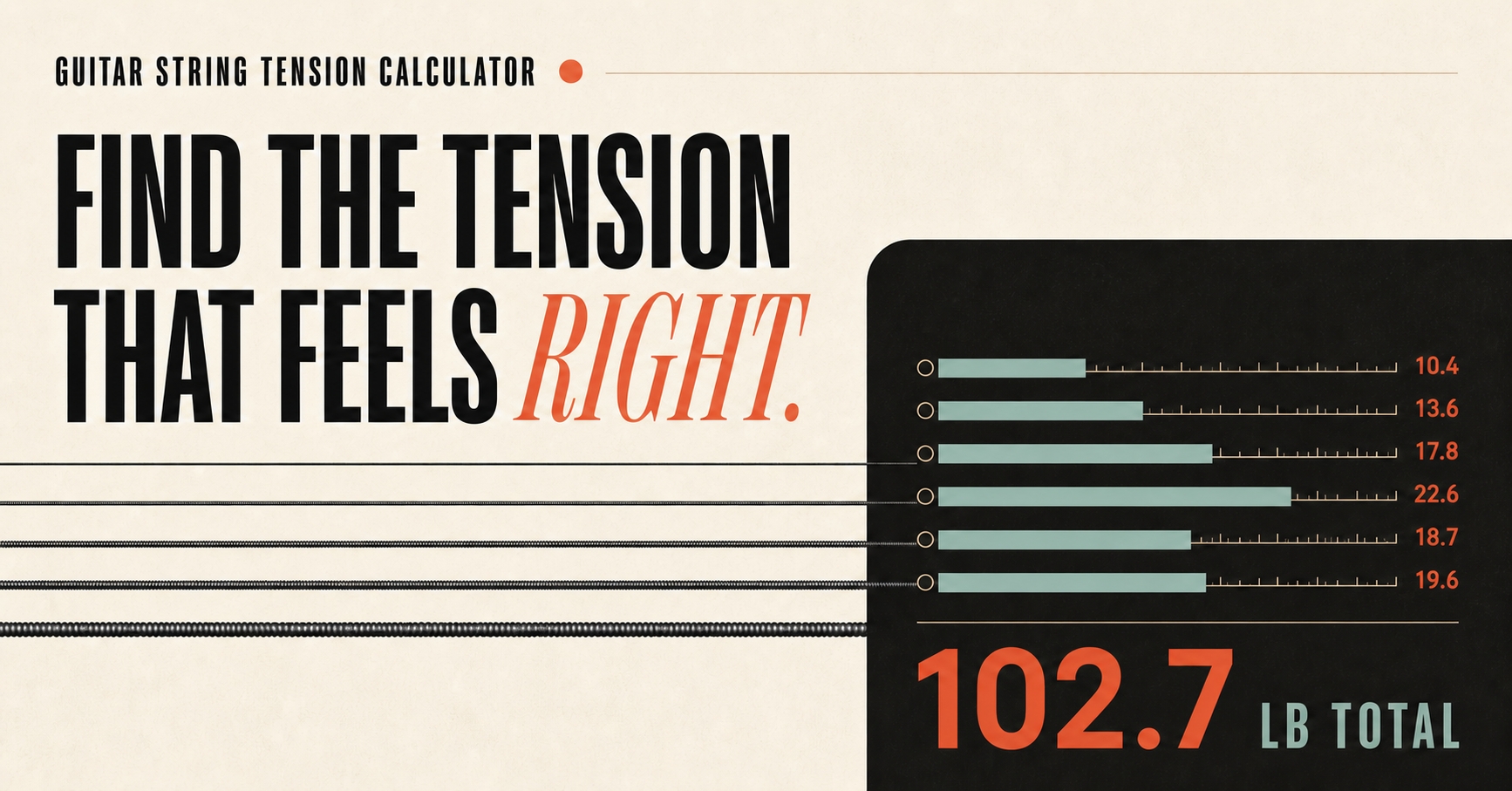
A total set tension is useful for understanding how strongly the strings pull on the neck and bridge, but it does not describe how the guitar responds one string at a time. Two sets can both total about 100 pounds-force while placing that force very differently across the fretboard.
Compare the shape
Imagine one set where every string sits between 15 and 18 lbf. Now imagine another with a 12 lbf dropped sixth string and a 22 lbf third string. The totals may be similar, yet the first set will usually feel more consistent during picking and fretting.
That distribution is the tension profile. It is why Guitar String Tension Calculator shows individual bars, an average, and a spread instead of presenting only one large number.
Balanced does not mean identical
Equal numerical tension is not automatically ideal. Plain and wound strings differ in stiffness. A wound string with the same tension as a plain string may resist bending differently because of core diameter and wrap construction.
Players may also prefer a firmer bass side for hard picking or a softer treble side for wide bends.
The useful goal is deliberate variation. A profile makes that choice visible.
A repeatable adjustment method
Start with a guitar setup you already like. Enter the real gauges, tuning, and scale length in the tension calculator. Save the per-string values.
After changing tuning, use reverse gauge mode to solve for gauges near those original values.
Round the results to gauges that are actually available, then inspect the spread again. This method turns an uncertain pack choice into a controlled comparison while still leaving room for technique and string construction.
For the underlying equation and model limitations, read the guitar string tension methodology.
Read three profile features before the total
Start with the lowest and highest per-string values to see the spread. Then inspect adjacent jumps because the hand crosses neighboring strings, not a theoretical average. Finally compare bass-side and treble-side shapes with the musical task: hard rhythm may favor a firmer bass while wide bends may favor a softer treble.
The median can describe the center without being pulled as strongly by one outlier. None of these statistics defines good feel on its own. They make a preference visible so it can be repeated after a tuning or scale change.
- Range: highest minus lowest tension in the set.
- Adjacent jump: change from one string to the next.
- Median: the middle value after sorting the strings by tension.
- Slope: whether the profile intentionally rises toward bass or treble.
Why equal totals can hide opposite playing experiences
The same trap shows up off the six-string guitar, too. Picture two five-string bass sets that both total about 80 lbf: Set A keeps every string within two pounds-force of 16, while Set B reaches the same total by pairing a firm 19 lbf low B with a noticeably softer 14 lbf G, chasing a punchier low end at the cost of treble consistency.
The neck and bridge see a similar total either way, but the picking and fretting hands encounter very different transitions.
Now imagine both sets use different wound-string constructions. Even the set with smoother numerical values may not bend or intonate uniformly. A profile is a better map than a total, but it remains a map of open-string pull rather than a complete mechanical model.
| Question | Useful number | What it cannot answer alone |
|---|---|---|
| How much total load changes? | Set total | Which string feels different |
| Where is the outlier? | Per-string values and spread | Whether the player likes it |
| Can I reproduce a familiar setup? | Control profile and ratios | Product construction and setup effects |
| Will bends feel identical? | No single tension statistic | Bending stiffness and guitar geometry matter |
Turn a preferred profile into a repeatable design loop
Capture the setup you already like, including product line and construction. Change the tuning or scale in the calculator while leaving gauges fixed to reveal the new profile. Adjust the largest outliers first and round to available singles or sets, then calculate the real rounded result again.
Install the smallest practical change and test the same passage. Record whether attack, bends, fretting pitch, and fatigue improved. A successful profile is the one that supports those tasks on the actual instrument, not the one with the prettiest graph.
Use the profile to choose the smallest useful change
If one string feels wrong, compare it with both neighbors before replacing a complete set. A dropped sixth may be the only low outlier, a plain third may be the firm point between two groups, or a factory hybrid set may already contain an intentional bass jump. The graph helps identify where to test, not what every value should be.
Change the suspected string by one available step and recalculate the rounded set. Watch how the total changes, but prioritize the local transition you are fixing. A custom single can preserve five familiar strings and make the result easier to evaluate than a new package with several different intermediate gauges.
If multiple neighboring strings move together after a tuning change, compare a sectional adjustment: treble group, wound middle, or bass group. Keep product construction consistent when possible. Recheck relief and bridge balance if the sectional change materially alters total pull.
| Profile pattern | Small first experiment | Do not overlook |
|---|---|---|
| One low outlier | Change one string gauge | Nut fit and intonation |
| Whole bass side soft | Adjust wound group gradually | Total pull and bridge balance |
| Large plain-to-wound jump | Compare third-string construction | Bending stiffness versus open tension |
| Numbers smooth but feel uneven | Compare product and setup variables | Core ratio, action, and technique |
Reference material
Technical references
Use these references when you need the source equation, product-specific information, or a second explanation of the setup method.
- What Is Guitar String Tension?D'Addario
- Balanced Tension Guitar StringsD'Addario
- Guitar String Tension CalculatorStringjoy
- String Tension Charts for TuningElixir Strings