Start here
Key takeaways
- Treat the low B as part of a seven-string tension profile instead of choosing the largest gauge that fits.
- A shorter scale needs more unit weight than a longer scale for the same B1 target tension.
- A longer bass scale can improve response without an extreme outside diameter.
- Confirm tuner, nut, bridge, and intonation capacity before committing to the final string.
How to use this: Use the examples to compare options, then confirm product-specific details with the linked manufacturer references and your own instrument.
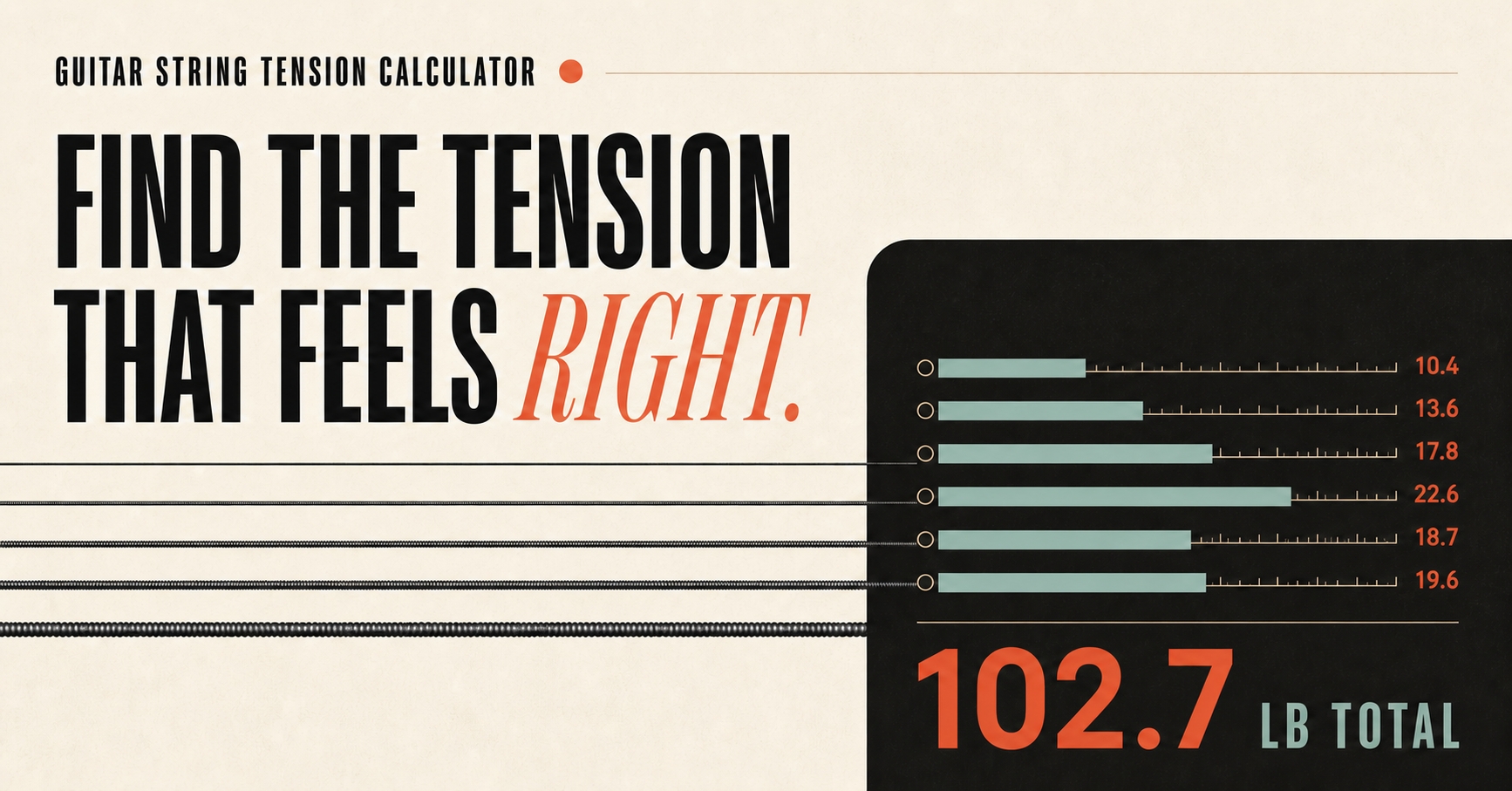
The standard seven-string tuning adds B1 below the familiar E2–A2–D3–G3–B3–E4 set. That low note needs enough mass and speaking length to reach pitch without becoming noticeably softer than the sixth string.
Start with the sixth string
Enter the upper six gauges and note the E2 tension. Decide whether the seventh string should match that number, sit slightly firmer, or remain softer for vibrato.
Reverse gauge mode can solve for a B1 gauge at the actual scale. A 25.5-inch guitar generally needs more gauge than a 26.5- or 27-inch guitar for the same numerical target.
Avoid solving everything with diameter
Very thick strings can become stiff and may not fit the tuner, nut, or bridge. A longer bass-side scale often provides a cleaner solution because it raises tension without requiring as much diameter.
Wound-string construction also matters. Two .060 strings may have different core sizes and feel different even if open-string tension is similar.
Check the complete instrument
After selecting the string, verify tuner-post capacity, nut clearance, bridge travel, and intonation. A large change in the seventh string may not transform total neck pull dramatically, but it can expose a nut slot or saddle limitation.
The seven-string gauge guide provides starting sets across several scales, and the main calculator includes seven-string and multiscale layouts.
Build the low B from a known sixth-string response
Start by measuring the E2 string you already like: scale, gauge, product, and estimated tension. Decide whether B1 should match that open-string pull, run slightly firmer for attack, or remain softer for vibrato. This creates a target tied to your hands instead of copying a gauge from an instrument with another scale.
Longer scales need less unit weight for the same pitch and tension. That is why a .059 or .060 may work on one 27-inch guitar while a shorter instrument needs a larger or differently constructed string. Use the result as a comparison range, then play-test real products.
| Low-B symptom | Possible cause | First check |
|---|---|---|
| Note wavers under attack | Low tension or forceful picking | Compare one nearby heavier gauge |
| Pitch is stable but tone is dull | Excess stiffness or pickup response | Compare construction or longer scale |
| First frets play sharp | High nut slot or excess pressure | Inspect setup before adding gauge |
| Cannot intonate with saddle fully back | Gauge, construction, or bridge travel mismatch | Confirm scale and hardware capacity |
Check whether the guitar can accept the proposed string
A numerical match is useless if the string cannot pass through the tuner, clamp, bridge, or ferrule. The nut slot should support the string without pinching, but irreversible widening should be done carefully because returning to a smaller gauge may leave poor lateral support.
Very thick strings can also have a wound section that lands incorrectly on a tuner post or saddle. Confirm winding length and taper placement for extended-scale and string-through instruments. These fit details are product-specific and are not inferred from outside gauge.
- Tuner-hole or locking-clamp capacity.
- Nut-slot width, depth, and break angle.
- Bridge, ferrule, and saddle opening.
- Available saddle travel and pickup clearance.
- Wound length for the actual scale and tail geometry.
Evaluate the seventh string in musical context
Compare the low B with the low E using alternating picked notes, palm-muted rhythms, and a fretted octave. Record the transient because gain can hide a soft fundamental while emphasizing pick noise. Check clean chords as well; a string that works for single-note attack can still go sharp under firm fretting.
Set relief and action before final intonation, and use fresh strings for the comparison. Save the complete seven-string profile after the setup works. The next tuning or scale change can then be solved against your own control rather than a generic set chart.
Use a recording test to separate pitch, attack, and low-end buildup
Record a direct input as well as the processed amp sound. The direct track exposes the initial pitch and note envelope, while distortion, gating, and cabinet response show how the string behaves in the finished tone. Use the same pick position and input gain for every gauge.
Compare the first 200 milliseconds of palm-muted notes as well as the sustain. A softer string may begin sharp under a hard hit and settle correctly; an overly stiff string may hold pitch but produce a dull fundamental or strong pick noise. Listen at matched loudness so output does not decide the test.
Then play the low B against the E string in a repeated alternating pattern. The goal is not identical waveform shape but a deliberate transition in attack and pitch stability. If processing is hiding the difference, reduce gain and compression until the mechanical response is audible.
Save the take names with gauge, product, scale, tuning, and pick. Without those labels, a useful listening test turns into two anonymous files and cannot guide the next string purchase.
Repeat the chosen setup on another day before modifying hardware. A result that survives fresh ears and normal playing is stronger evidence than one impressive take.
- Direct track: pitch start, settling, and raw string output.
- Clean amp: fundamental balance and fretted clarity.
- Driven amp: palm-muted control and harmonic buildup.
- Full mix: whether the low note remains defined with bass and drums.
Reference material
Technical references
Use these references when you need the source equation, product-specific information, or a second explanation of the setup method.
- String Tension Specifications and FormulaD'Addario
- Intonation After String ChangesFender
- Strings for a 7-String GuitarStrings and Beyond
- Finding the Right String Gauge for Metal PlayersSeymour Duncan
- String Gauges for Standard and Lower TuningsErnie Ball