Start here
Key takeaways
- A plain and wound third can share an outside gauge without sharing unit weight or bending stiffness.
- Plain thirds generally support wider bends; wound thirds often improve pitch stability and tonal continuity.
- Changing construction can move the correct saddle position.
- Use product unit-weight data when exact tension matching matters.
How to use this: Use the examples to compare options, then confirm product-specific details with the linked manufacturer references and your own instrument.
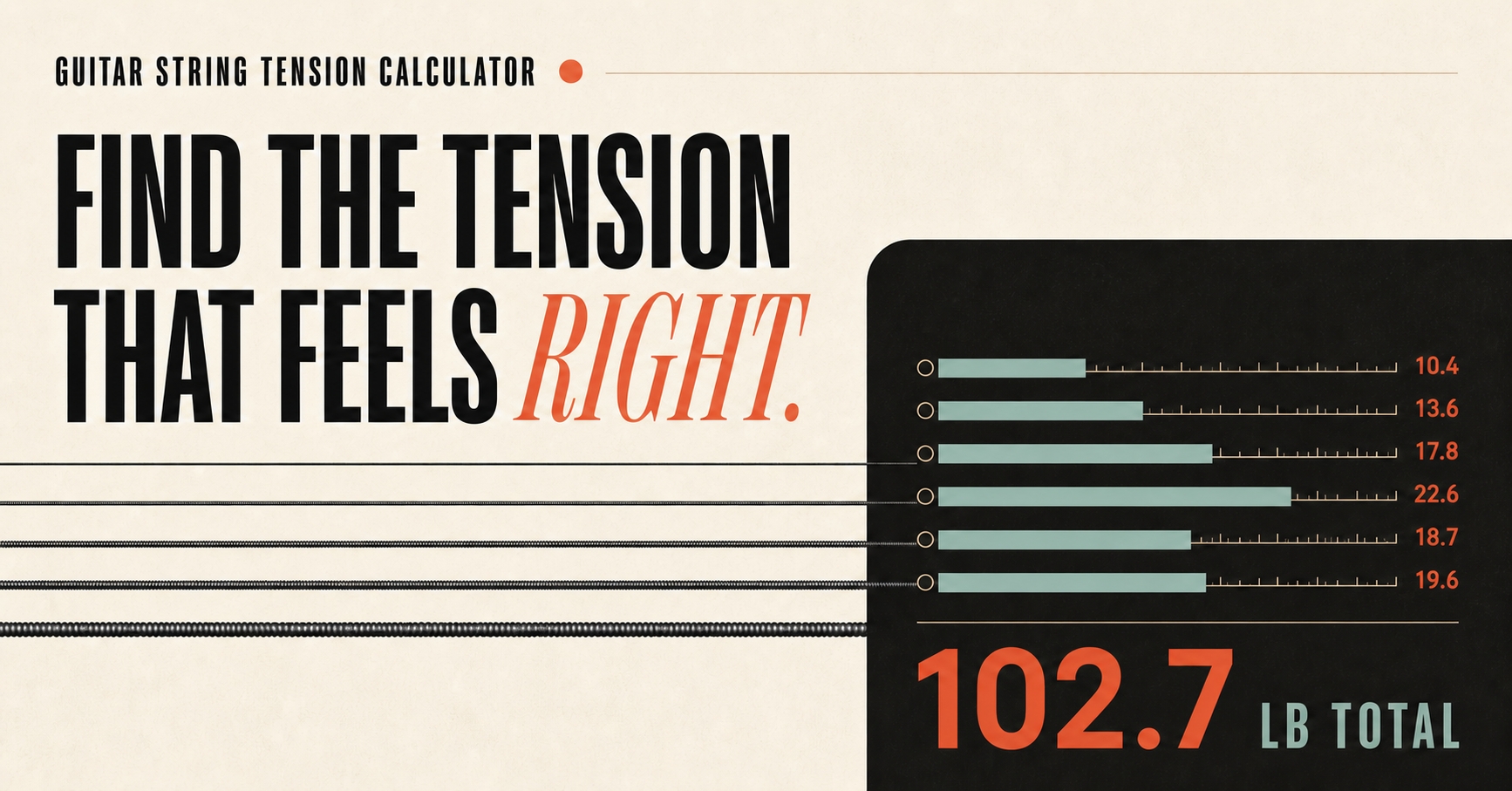
The third string sits at a transition point. Many electric sets use a plain G string, while jazz, acoustic, and heavier sets may use a wound third. The two constructions can share a similar outside gauge but behave very differently.
Bending and fretting feel
A plain string is one wire. Its flexibility is strongly tied to that full diameter. A wound string carries much of its mass in the wrap around a thinner core, so the relationship between outside gauge and bending feel changes.
Players usually find a plain third easier to bend through large intervals. A wound third often feels more stable under fretting pressure and can produce a more even tonal transition into the wound bass strings.
Intonation consequences
Plain third strings often need substantial saddle compensation because their stiffness and fretting stretch differ from the wound strings beside them. Switching to a wound third can move the correct saddle position. The guitar should therefore be re-intonated after the change.
Do not compare gauge alone
A .018 plain and .018 wound string do not necessarily have the same unit weight or open-string tension. The core and wrap construction of the wound string matters. For an exact comparison, use product unit-weight data.
Guitar String Tension Calculator treats strings below .020 as plain by default and applies a wound-string model above that point. This is a practical convention, so choose the actual construction of your third string when it differs from the default.
Need to convert a diameter or check where the plain/wound line falls for a given set? The gauge chart has the conversions, and the tension guide documents exactly where this site’s model draws that line and why.
Choose the third string around the music you play
A plain third is usually the easier choice for wide blues and rock bends because the whole wire bends as one solid section. A wound third often gives jazz chords, clean rhythm, and archtop sets a smoother tonal and tactile transition from the fourth string. Neither construction is inherently more professional or more accurate for every guitar.
Gauge alone does not settle it, either. The plain/wound boundary itself moves between manufacturers — a .020 is sold wound in some sets and plain in others — and two strings sharing that number can still land noticeably apart in open-string tension once core and wrap are accounted for. Compare named products or published unit weights when the target is precise.
| Priority | Plain third tendency | Wound third tendency |
|---|---|---|
| Wide bends | Usually easier | May require more effort |
| Chord pitch under firm fretting | Can be easier to push sharp | Often more stable |
| Tonal transition to string 4 | More distinct | Often smoother |
| Saddle position | Often needs more compensation | Usually changes after the swap |
Use a short playing test before committing
Play a whole-step bend, a first-position open chord, a movable major-third interval, and a clean single-note line across strings 2–4. Listen for pitch under pressure, not only brightness. Then repeat through the stage or recording sound you use, because gain and compression change which differences remain audible.
If the wound third solves chord pitch but makes the required bends impractical, try a lighter wound option or keep the plain string and address nut height, action, and technique. The correct choice should support the repertoire rather than satisfy a rule about set construction.
- Tune and stretch the new string until the reading is stable.
- Match pick attack and fretting pressure between tests.
- Check magnetic pickup balance; a wound string may change output.
- Record the exact gauge and construction that produced the result.
Recheck the setup after changing construction
Inspect the nut slot for clean travel without widening it blindly. Set relief and action with the final set, then compare the open string with the 12th-fret fretted note and move the saddle as required. A previous saddle position is not evidence that the new construction is wrong.
If intonation remains inconsistent across the neck, look beyond the saddle. High action, tall frets, excessive pressure, worn strings, and an incorrectly cut nut can all move pitch. Construction is one part of that system.
Check pitch behavior across the places the third string causes trouble
Tune the open G carefully, then compare the 12th-fret harmonic and fretted note with normal pressure. Continue with notes at frets 2, 5, 9, and 15. A consistent octave error can guide saddle movement, while sharpness concentrated near the nut points toward nut height or pressure.
Play the G string together with stable reference notes on neighboring strings. Major thirds and octaves reveal beating that a fast tuner display can make difficult to interpret. Test both single notes and chords because the wound option may improve pressure stability while changing the blend with strings 2 and 4.
Repeat after the string has settled. A kinked, dirty, or unevenly seated string can intonate unpredictably and should not be used to judge the construction category. If the new string requires a saddle position outside the bridge’s range, record the gauge and consult a repairer before altering fixed hardware.
- Open and 12th-fret mismatch across the neck: adjust saddle after setup checks.
- Mostly first-position sharpness: inspect nut slot and pressure.
- Unstable or warbling pitch: replace the test string and inspect pickup height.
- Good pitch but wrong playing response: choose around repertoire, not the graph.
Reference material
Technical references
Use these references when you need the source equation, product-specific information, or a second explanation of the setup method.
- Electric String Materials and ConstructionD'Addario
- String Tension Specifications and FormulaD'Addario
- What's a Wound 3rd and Do I Need One?Strings Direct
- Wound G String: Is It Right for You?Stringjoy
- XL Nickel Wound Set with Wound ThirdD'Addario