Start here
Key takeaways
- Validate the equation and the string model as two separate questions.
- Confirm note octave, scale, gauge units, and output units before judging a result.
- Use published unit weight for product-specific wound-string comparisons.
- Relationship tests such as octave and scale doubling expose calculation errors.
How to use this: Use the examples to compare options, then confirm product-specific details with the linked manufacturer references and your own instrument.
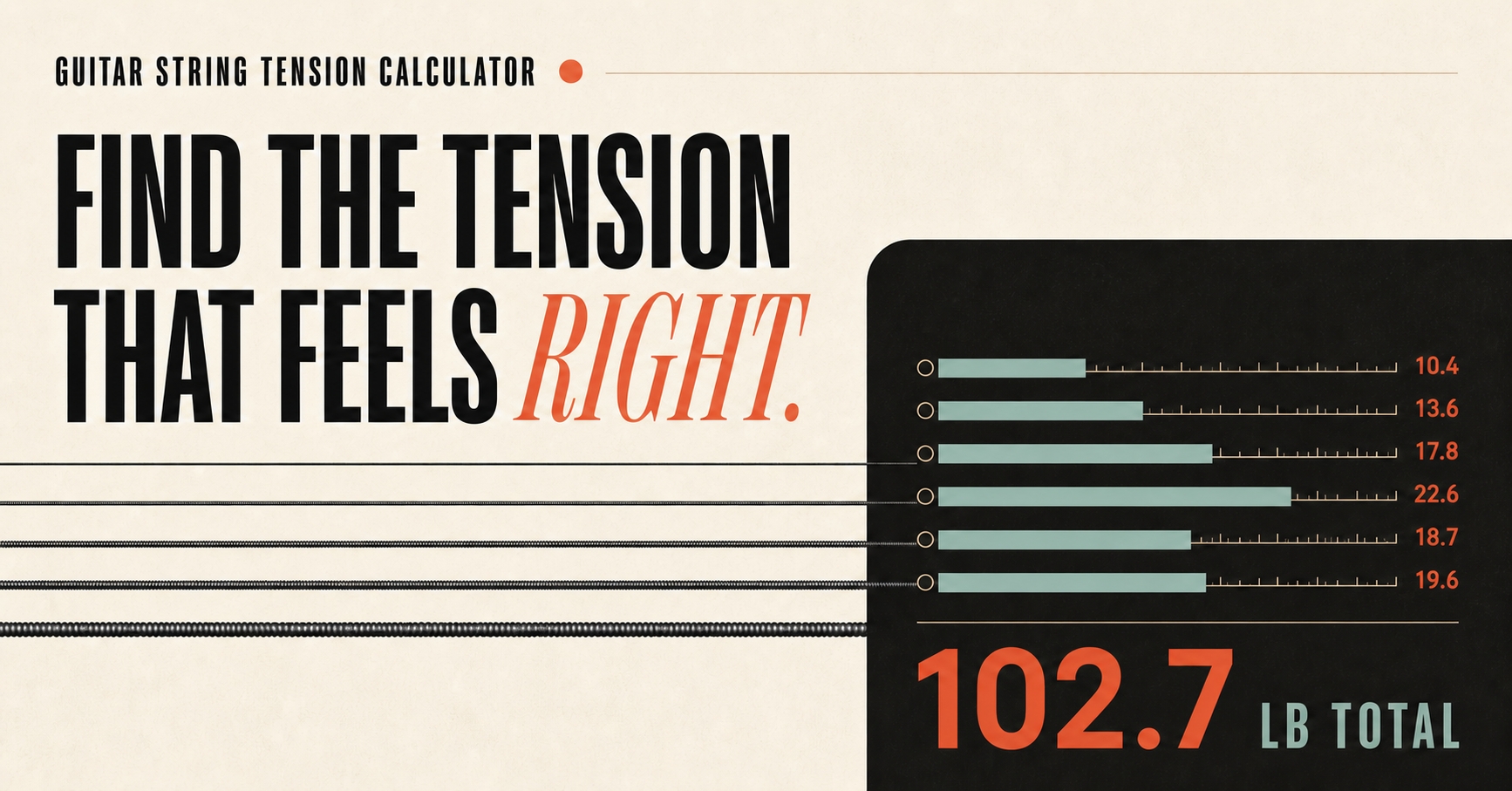
A calculator can apply the tension equation correctly and still produce an imperfect estimate if its unit-weight input does not match the real string. Validation therefore needs two separate questions: is the equation implemented correctly, and does the string model describe the product?
Verify deterministic inputs
Confirm the note and octave, scale length, gauge units, and output units. E2 and E3 differ by an octave and require four times the tension at the same string and scale. A centimetre value entered as inches creates an even larger error.
Use known reference cases
For a plain steel string, derive unit weight from steel density and circular area, then compare the result with a published table. Known standard-tuning sets provide a useful plausibility check across multiple gauges.
Treat wound strings separately
Outside diameter does not reveal core and wrap proportions. If a manufacturer publishes unit weight, use it. If not, compare the generic model across several known products and report the expected uncertainty instead of hiding it.
Test relationships, not only outputs
Doubling frequency should multiply tension by four. Doubling scale should also multiply it by four. Reducing frequency by one semitone should multiply tension by 2⁻¹⁄⁶, approximately 0.891.
These relationship tests catch calculation errors even when no product table is available.
Guitar String Tension Calculator publishes the tension equation and its limitations. If a result does not match a cited product table, send the full setup through the contact page so it can be reproduced.
Validate from units to products in four layers
Begin with dimensions: length, frequency, and mass per unit length must use compatible units. Next test mathematical relationships that do not depend on a particular product.
Then compare a plain steel reference where geometry is simple. Only after those checks should you judge a wound-string model against manufacturer data.
This order separates a calculation error from a modeling difference. If octave and scale ratios pass but one wound string disagrees, the equation may be correct while the assumed core and wrap construction differs from the real product.
- Check note octave, scale unit, gauge unit, and output unit.
- Verify one-semitone, octave, and scale-length ratios.
- Compare a plain steel string with a published unit-weight case.
- Compare several wound strings from the same named product family.
- Report the remaining difference as model uncertainty rather than silently tuning constants to one example.
Use relationship tests that expose common failures
At fixed unit weight, doubling frequency must quadruple tension, and doubling speaking length must do the same. Moving down one equal-tempered semitone multiplies tension by about 0.891. These checks catch a missing square, a wrong octave, and several unit-conversion errors without relying on one manufacturer table.
A reverse-gauge calculation should also round-trip: calculate a known string’s tension, solve for gauge at the same inputs, and confirm that the original value is recovered within the model and display precision. Run the test separately for plain and wound modes.
| Test change | Expected tension ratio | Failure it can reveal |
|---|---|---|
| Frequency × 2 | 4.000 | Missing frequency square or wrong octave handling |
| Scale × 2 | 4.000 | Length conversion or missing length square |
| Pitch down one semitone | About 0.891 | Note-frequency mapping error |
| Same inputs, lb to kg display | Same physical force | Output conversion error |
Create an error budget for the result you publish
List known inputs separately from inferred inputs. Scale and pitch may be measured closely, while a generic wound-string core ratio is an assumption. Display precision should reflect that difference; many decimal places do not make an unknown construction exact.
For a setup comparison, consistent modeling can still be useful because the direction and approximate size of a tuning or scale change remain informative. For reproducing a named product, replace the generic unit weight with manufacturer data where available and keep the citation with the result.
Write a validation case that survives handoff
Name the exact string product, gauge, note with octave, speaking length, and source unit weight. State whether the published tension uses the same scale and reference pitch. A screenshot without those inputs is not enough because several plausible combinations can produce similar displayed values.
Show conversions explicitly once. If the source uses pounds per linear inch and the calculation uses SI mass per length, save the converted intermediate value and constants. This makes a factor-of-12, factor-of-25.4, or force-versus-mass mistake visible to the next reviewer.
Record expected and actual results with an acceptance tolerance suited to the source precision. Exact equality may be unreasonable when the table is rounded. For a generic wound model, compare the direction and approximate magnitude separately from a product-specific pass/fail case.
Run the same case after any formula, conversion, or string-model change. A small fixed suite of plain, wound, alternate-pitch, and long-scale examples prevents an improvement for one product from quietly breaking a relationship that already worked.
Keep failed cases as well as passing ones. Their history documents the boundary of the model and shows whether a later change resolves the original discrepancy without changing the test conditions.
- Case ID and date.
- Product, construction, gauge, note, scale, and reference pitch.
- Source URL, source value, and source units.
- Converted inputs, calculated result, and difference.
- Pass criterion and explanation of any remaining model uncertainty.
Reference material
Technical references
Use these references when you need the source equation, product-specific information, or a second explanation of the setup method.
- String Tension Specifications, Unit Weights, and FormulaD'Addario
- String Tension Gauge CalculatorEverTune
- String Tension: Theory and MeasurementUniversity of Sydney